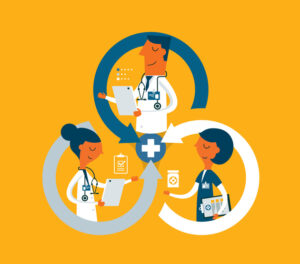
How Team-Based and Virtual Nursing Models Are Redefining Care Delivery
Care delivery doesn’t have to be binary — in-person or virtual, old model or new. It can be adaptive, team-based, and deeply human.
These day-to-day issues are directly responsible for rising rates of clinician burnout, exacerbating the serious shortage of doctors and nurses facing the US in the next decade.
Small practices play a critical role in healthcare delivery, but they cannot continue to absorb ever-increasing administrative demands without consequences.
AI in healthcare will not fail because the models are weak. It will stall when leaders hesitate to redesign how decisions are made, measured and governed.
Today’s challenges — such as rapid technological innovations, shifting patient demographics, and mounting financial pressures — call not for just any leader but for a particular type of leader. They must be able to assess like clinicians and lead like CEOs.
The leaders who will thrive are those who can see both sides of every equation: mission and margin, empathy and efficiency, innovation and trust. They’re the ones building organizations that don’t just survive policy shifts and economic pressure, but use them as catalysts for progress.
Fragmented finance systems have long caused operational challenges. By addressing this, CFOs can optimize and streamline many finance processes to improve compliance readiness and create time for business-driven decisions that support business objectives.
Enterprise EHR boosts scalability, interoperability, and governance for large healthcare systems.
With life expectancy rising again post-pandemic, Americans increasingly are turning to senior communities.
With employee anxiety at an all-time high, reducing fear and stress is increasingly important to organizational performance. While leaders cannot control external events, they can help mitigate their impacts on their organizations and people.
Leading in healthcare when the odds are stacked against you is not about eliminating the challenges. It is about meeting them without losing sight of the reason we chose this profession in the first place.
Patient safety has lost its place on the priority list. Without strong, sustained attention from those at the top, safety efforts rarely take root.
The organizations that will thrive in this environment are those that invest in resilience — the capacity to adapt, absorb strain, and maintain performance in the face of volatility.
A Chief AI Officer is a strategic necessity to help hospitals navigate the opportunities, challenges, and risks associated with applying AI innovation to improve patient care.
A strategic orientation that leans into emerging value, even when this challenges our assumptions about who we are and what we do and the niche we do it in, enables organizations to make distinctive contributions sought by others.
As a result of ever-growing cybersecurity threats, health systems are prioritizing the role of the chief information security officer, according to a consultant at WittKieffer.
Emphasize the development of team members of all roles with multiple options for various leadership interests.